


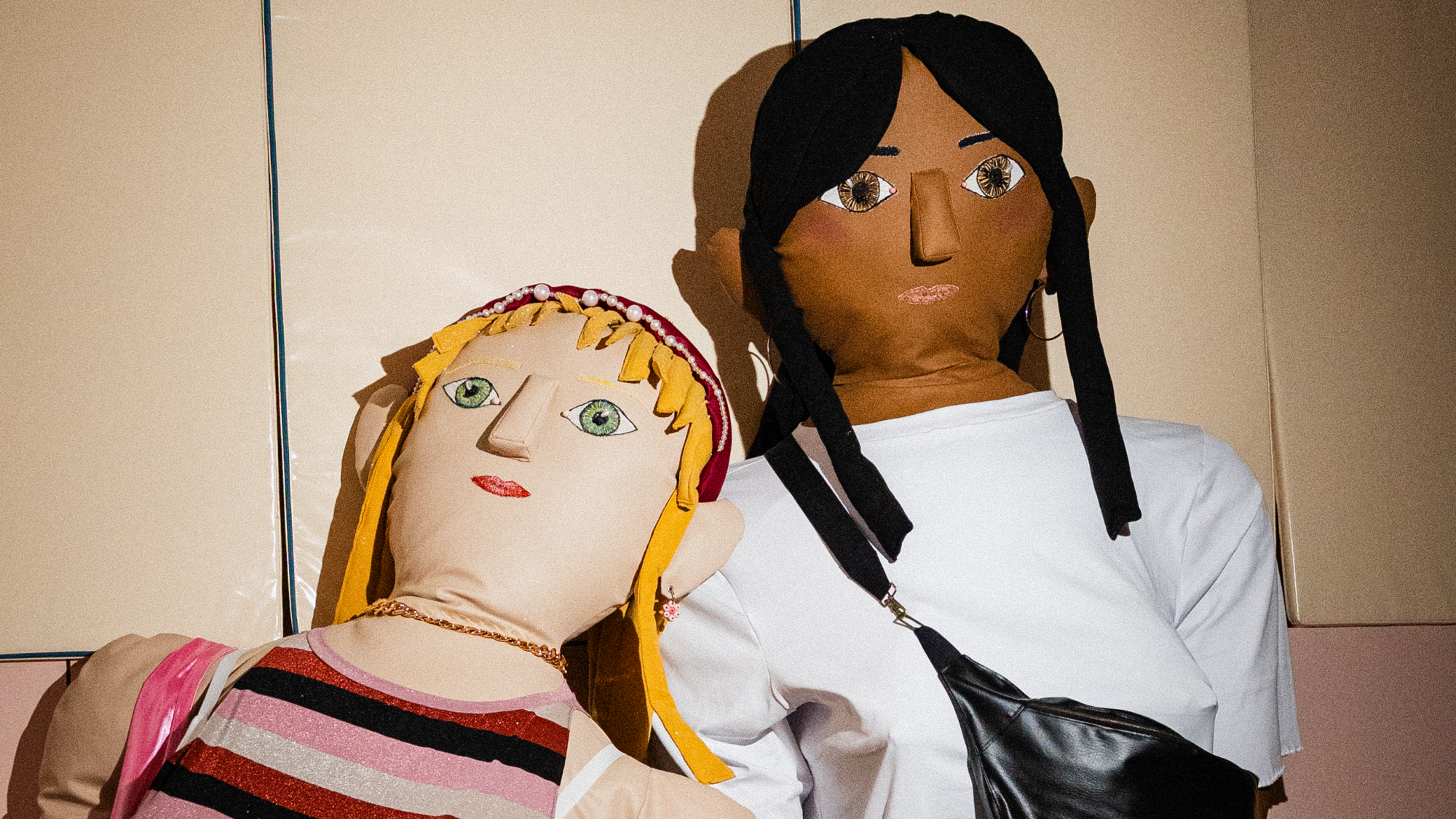
Girls to the Right, Boys to the Left
Sodja Zupanc Lotker, Tadeáš Říha (Czech Republic)Am I too sensitive? Too fat? Am I good enough? Will anyone like me the way I am? These are questions that begin to occupy our minds from an early age – as soon as we encounter the judgmental attitudes of those around us.
School and the gym – spaces where we become most acutely aware of our bodies, confronted by the gaze of our classmates and teachers. These places are on one hand defined by strict rules, on the other it is where we first begin to discover what our bodies can do, what they are capable of, and what they want. They are also often places without witnesses – moments when adults are absent, allowing social hierarchies, power dynamics, and violence to take root without intervention. Yet the presence of adults does not always guarantee protection. In many cases, abuse continues in plain sight – in silence.
The exhibition at the Latvian National Museum of Art, which has travelled from the Prague City Museum, invites visitors not to turn away from bullying and to speak openly about it within Latvian society as well.
EASY READ VERSION
We encounter judgement from an early age.
Other people judge us.
And we also start to judge ourselves.
We ask ourselves questions like:
- Am I too fat?
- Am I too sensitive?
- Am I good enough?
- Where do I belong?
- Will anyone like me?
Each of us wants to belong.
Each of us wants friends.
But children often make fun of each other.
This happens in schools and in changing rooms.
Children make fun of other’s appearance and abilities.
In changing rooms, children usually are alone.
Adults stay outside.
It is easier for children to bully others there.
The stronger and more confident children
push away the weaker and shyer children.
This is painful.
Children feel safer when adults are present.
However, sometimes adults do not step in.
Adults pretend not to see the bullying and exclusion.
And the weaker children are left alone and unprotected.
The exhibition “Girls to the Right, Boys to the Left” was created in Prague.
The exhibition encourages people to step up against bullies.
Adults must step in children’s conflicts.
Adults must protect the weaker and shyer children.
And we need to talk about bullying in Latvia as well.
ABOUT ARTISTS
Sodja Zupanc-Lotker, Ph.D, teaches dramaturgy and runs master studies at DAMU Department of Alternative And Puppet theatre in Prague. After finishing her master studies in directing and dramaturgy at DAMU, Prague she did her PhD in spatial dramaturgy at Vienna University, ZHdK University of the Arts Zurich and Prague Performing Arts academy. She works as a dramaturg for independent theatre, dance and exhibition projects in Czech Republic, Poland, Belgium, Norway and the Netherlands with Decoratelier/Jozef Wouters, Ahilan Ratnamohan, Fredrik Petrov, Julian Hetzel, Jan Mocek, Lotte van den Berg, TAAT, Wojtek Ziemilski a.o. She was artistic director of the Prague Quadrennial of Performance Design and Space 2008 – 2015. She has also served as coordinating curator for several international artistic research projects. She has given lectures and workshops at Columbia University, Yale School of Drama, Royal Central School of Speech and Drama, Iceland Academy of the Arts, Norwegian Theatre Academy, HKU Utrecht, Kiasma Helsinki and numerous festivals and symposia. From 2014-2026 she was on Editorial Board of Theatre and Performance Design Journal; and from 2015 – 2021 on Editorial Board of Performance Research Journal, both published by Routledge.
Tadeáš Říha is an architect, practising between London and Prague. Working across community buildings, urban design, exhibition-making, curatorial practice and teaching, the work establishes focused collaborations at the intersection of architecture, planning, sustainable engineering, and culture. Tadeas teaches at the Royal College of Art in London.
CREDITS
Muzeum Prahy in cooperation with Prague Pride
Concept: Sodja Zupanc Lotker, Tadeáš Říha, Broněk Stratil (RSAA)
Art direction: Broněk Stratil
Concept and Creative Production: Tereza Kadlecová, Aleš Rumpel
Text script: Sodja Zupanc Lotker and Santa Remere
Text editor: Andrejs Vīksna
Dolls design: Pedro Enrique Gramegna Ardiles & Jasmine Molinari
Production of dolls: Marie Adlerová, Lauren Alexander
Clothing design and Production: Tereza Váchová
Assistance: Lottie Wood, Jovita Siu, Simona Leveratto, Kateřina Ďurčanská, Kalyen
Latvian adaptation: Estere Betija Grāvere, Tadeáš Říha, Sodja Zupanc Lotker
Audio recording design: Henriks Eliass Zēgners
Voices: Antonija Skopa, Eižens Freimanis, Ģirts Dubults, Rihards Bargais, Linda Krūmiņa, Lote Vilma
Technical support: Raitis Upens, Ivars Ozols
Special thanks to: Laura Dravniece, Ņikita Bezborodova, Ondřej Mrázek, Aija Andersone
Translators: Ieva Lešinska
Proofreader: Aija Andersone
Local producer: Elza Siliņa (New Theatre Institute of Latvia)
Supported by: Satori
ACCESSIBILITY
Mobility and environment
The venue is accessible to people using wheelchairs. The entrance for people in wheelchairs is on the right side of the main entrance, through the marked door, and on the left side of the building, from the courtyard, behind the café.
The building has an elevator connecting all floors, accessible restrooms on the 1st floor across from the museum restaurant, as well as on the 4th floor. On the second floor, in the lobby near the information desk, a wheelchair and portable chairs (1.3 kg) are available for use within the museum. The chairs can also be conveniently used as a walking aid.
Next to the museum, on the right side of the main entrance, there is a designated parking space for people with mobility impairments
Sensory environment
This is a relaxed event. Large-format tactile dolls will be available. You will have the opportunity to share your story in writing, if you wish.
Relaxed performances are created with the needs of a neurodivergent audience in mind. During relaxed performances, people can move around, change their seats, walk out, and return if needed. We invite everyone to accept that the audience’s behavior could be freer than we are used to.
Availability of information
A printed version of the text accompanying the audio recordings will also be available at the exhibition. The information will be available in easy read version as well.
Support
If necessary, a festival volunteer can assist people with functional impairments at the event venue.
Important to know
The exhibition may evoke strong emotions.






Date
Location
Language
Accessibility


