


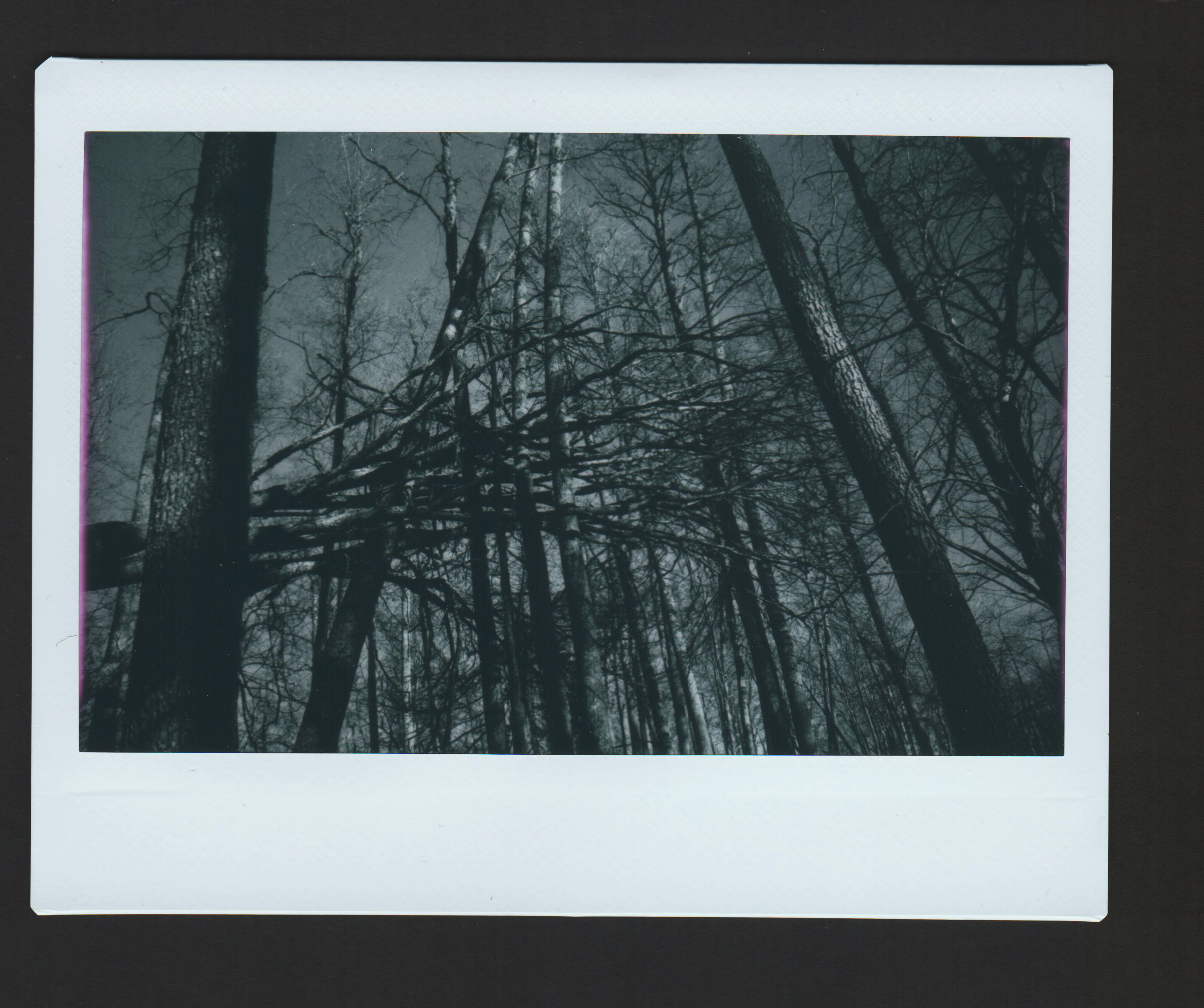
How Things End
Jānis Balodis, Nahuel Cano (Latvia, Netherlands, and Argentina)Three years ago, Jānis Balodis and Nahuel Cano began a process they titled How Things End.
Three years – and several endings – later, they sit on a chair in the middle of Ķemeri National Park, watching a river disappear into the forest.
Around them are a few more chairs, a few songs, a few notes, and a small black box whose contents echo, and echo again, endings and transitions.
This work unfolds as a soft dramaturgy: an invitation to follow a search for meaning within a perhaps meaningless quest – to understand the end of things. The end of dreams, the end of a time, the end of love, and the end of all ends: death.
For years, the artists have tried to face the collapse of things, holding on to small gestures of care and everyday attention. The search has led through dead ends and failures, but also – unexpectedly – to worlds within worlds, to life growing out of debris and decay.
EASY READ VERSION
Every day, something in our life ends.
Usually, these are small and simple things.
We do not pay attention to them.
But artists Jānis Balodis and Nahuel Cano
looked closely at endings.
They spent several years studying different endings:
- the end of a friendship,
- the end of dreams,
- the end of love,
- the end of life.
The artists found something surprising.
Every day something ends.
But something new starts in its place.
This is how nature works –
old leaves rot on the ground.
And then new plants grow there.
The same happens in human life.
An end is always the beginning of something else.
The artists worked on this performance for three years.
The show takes place in Ķemeri National Park.
Jānis and Noel sit on chairs.
They watch a river.
The river disappears into the forest.
Around the artists, you will see:
- a few chairs,
- recorded songs,
- photographs,
- boxes filled with different objects.
All of these things show the end of a story.
When we pay attention,
we can see both small and big endings.
But we can also see new beginnings.
The artists invite everyone to look
for these new beginnings together.
ABOUT ARTISTS
Jānis Balodis and Nahuel Cano work together in an informal, long-term collaboration that moves between theatre, music, poetry, and performance. While maintaining independent artistic practices, they come together to develop specific projects through what they describe as a slow cooking of questions and performative strategies. They began working together during their studies at the DAS Theatre Master program in Amsterdam in 2018, and since then their collaboration has unfolded through different iterations, formats, and research phases. Their most notable shared work is The Last Night of the Deer.
Nahuel Cano (born 1982 in Neuquén, Argentina) is a performer, theatre-maker, and composer working across performance, music, and sound. His practice is grounded in listening as an artistic and political tool, and explores how ecological histories, place, and affect can be translated into musical and performative forms.
Jānis Balodis (born 1987 in Riga, Latvia) is a playwright, dramaturg, and performance maker whose work interrogates social and political realities, creates theatrical situations with communities, and blends documentary and poetic approaches. He has contributed to numerous productions across the Baltic region and beyond.
credits
Makers – performers: Jānis Balodis and Nahuel Cano
Space design and location advice: Kate Krolle
Dramaturgical advice and inspiration: Teodēzija Balode
Production: Ieva Briede (New Theatre Institute of Latvia)
Accessibility
Mobility and Physical Access
The performance takes place in Ķemeri. If you are travelling to the performance by train, you will need to get off at Ķemeri Station, where the platform is low-level.
This means that wheelchair users must inform the ticket conductor when boarding the train that they will be getting off at Ķemeri Station and will require assistance with a ramp. This is necessary so that the train driver can allow extra stopping time at the station.
Wheelchair access to the train is only possible through the entrance doors of the first carriage.
For the return journey, when the train arrives, please go to the boarding doors of the first carriage and press the button marked with the wheelchair symbol. This sends a signal to the train driver and conductor, who will provide assistance using a ramp.
Please note that the route down from the platform at Ķemeri Station is uneven and has a very steep slope. For safety reasons, assistance is recommended on this section.
Festival volunteers will be waiting by the platform to help visitors navigate this section and will also accompany them to the performance venue.
The journey from the station to the venue will take approximately 45 minutes at walking pace.
A wheelchair ramp will also be available at the performance venue.
Sensory Environment
This is a relaxed performance. Audience members are welcome to move around freely, change seats, leave the performance if needed, and return afterwards.
Neurodivergent audience members are especially welcome, and everyone is encouraged to respond with understanding and acceptance to a more relaxed approach to audience behaviour during the performance.
The performance was created as part of the EU Creative Europe programme project The Big Green. With financial support from the Ministry of Culture of the Republic of Latvia. The work is being carried out in cooperation with the Pierīga Regional Administration of the Nature Conservation Agency. Special acknowledgment to Agnese Balandiņa. The New Theatre Institute of Latvia is responsible for the content of the performance.






Date
Entrance
Registration closedLength
Location
Language
Accessibility


Notes
If you are planning to travel with your own vehicle, please arrive 15 minutes before the performance begins.
If you are travelling by train, you should leave Riga Central Station at 9.30 am (for the 11.15 am performance), 11.30 am (for the 13.15 performance) and 13.30 (for the 15.15 performance).
If you arrive at the venue by train, the walk there and back is approximately 7 km.
Outdoor performance. Clothing appropriate for outdoors and weather conditions recommended. If necessary, please bring reading glasses.